
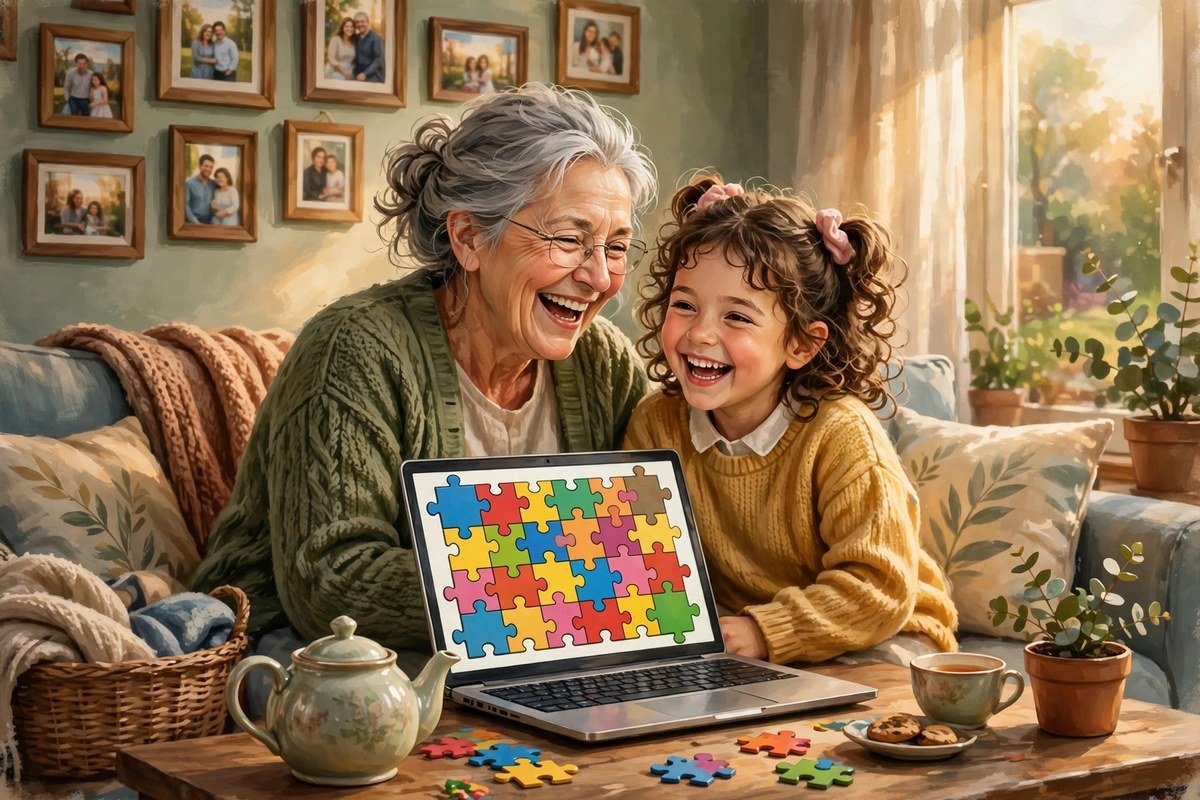
There is a particular kind of afternoon that every family knows: the grandparents visit, the grandkids are somewhere between bored and restless, and everyone is looking for something to do together that does not involve a screen nobody else understands. A browser game solves this in about two minutes. No console to set up, no account to create, no controller to learn — just a laptop, a game that opens in a tab, and two people taking turns. It is the simplest shared activity a family can start, and it is the one most families never think of.
1. Why Browser Games Work Across Generations
The gap between a grandparent and a grandchild is not really about age. It is about familiarity. The grandchild has grown up with games; the grandparent, often, has not — or has not played one since the games were simple. A modern console game widens that gap: it has thirty buttons, a camera to control, and a tutorial that assumes you already know the basics. A browser game closes it, because a browser game usually has one idea, two or three controls, and a first level that teaches itself.
That simplicity is what makes the sharing work. A grandparent can learn a sliding puzzle in a minute, because the rules fit in a sentence. A grandchild can teach it, because teaching something simple is easy and satisfying. And once the grandparent understands the game, the grandchild has a genuine opponent — not someone being humoured, but someone playing properly. That is the moment the game stops being a favour and starts being a match.
The other advantage is practical. A browser game runs on whatever computer is already in the house. There is nothing to buy, nothing to install, and nothing to update. The game opens in a tab, and when the visit is over, it closes. It is the lowest-friction shared activity there is, which is exactly what a family visit needs.
2. The Best Games for Two Generations
The games that work best across generations share three qualities. First, they are turn-based or slow enough that nobody feels rushed. A sliding puzzle, a match-three, a board game — these give both players time to think, and time to talk while they think. Second, they have no hidden knowledge. If the grandchild knows a trick the grandparent does not, the game is unfair, and unfair games are not fun for anyone. Third, they are easy to watch. A game where the whole board is visible is a game a spectator can follow, and half the fun of playing together is watching the other person play.
Board games are the classic choice for a reason. A game of draughts on a screen is the same game grandparents played on a wooden board, with the same rules and the same satisfactions — and the computer enforces the rules, so nobody has to argue about them. Puzzle games are the other natural fit. A merge puzzle or a sliding puzzle is a conversation as much as a game: "try that one", "no, the other corner", "look, you nearly had it". The talking is the point.
Fast games can work too, but they work differently. A timing game or a simple arcade game is best played in short turns — one person plays, the other watches and cheers, and then they swap. The turn-taking matters more than the game. It gives each player a role, and the roles keep switching, which is what keeps everyone involved.
3. How to Set Up the Afternoon
The setup is the easiest part, and it is worth doing properly. Pick one game before the visit, not five — choosing is half the battle, and five options means ten minutes of indecision. Open it on the biggest screen in the house, because a game everyone can see is a game everyone can join. Sit side by side, not across the room, because the game is an excuse to be near each other, not a reason to stare at separate screens.
Then let the grandchild teach. This is the part that matters most. The grandchild knows the game, or will learn it in thirty seconds, and teaching it is a genuine responsibility — the kind children take seriously when you let them. The grandparent's job is to ask questions, make mistakes out loud, and take the game seriously enough that winning it means something. The grandchild's job is to be patient, which is easier than it sounds when you are the expert for once.
Keep the session short. Thirty minutes is plenty — long enough for several games, short enough that nobody gets tired. End on a high note, while everyone still wants one more round. That is how you make sure there is a next time.
4. What the Afternoon Actually Gives You
It would be easy to describe this as a nice way to pass the time, and it is. But it is also something more specific. For the grandchild, it is a chance to be the expert in the room — a rare and valuable feeling for someone who is usually the one being taught. For the grandparent, it is a chance to meet the grandchild on the grandchild's own ground, in a world the grandchild understands, and to be genuinely interested in it rather than politely curious.
And for both of them, it is a shared memory that belongs to neither generation alone. The game is the excuse. The afternoon is the point. A browser game will not change a family, but it can give a family thirty minutes together that would otherwise have been spent in separate rooms — and thirty minutes, repeated often enough, adds up to something real.
At Volton, the games are free, they open in a tab, and they need nothing installed. The next time the grandparents visit, try it: one laptop, one game, two players, and half an hour. The grandkids will remember who taught them the game. The grandparents will remember who beat them at it.
6. The Rematch: Why the Second Visit Is Better Than the First
The first time grandparents and grandkids play together, the game is new to everyone and the afternoon is a discovery. The second time is better, and the reason is simple: the second time, there is history. Someone won last time. Someone wants revenge. Someone has been practising — or claims to have been practising — and the rematch has stakes that the first game never had.
History is what turns a pleasant afternoon into a tradition. The first visit establishes the game. The second establishes the rivalry. By the third, there are running jokes, disputed results, and a score that everyone remembers differently. The grandchild claims the win was fair. The grandparent claims the grandchild had an unfair advantage. Both are half right, and the argument is the point — it is the story the family tells at dinner, and the story is what brings everyone back for the next round.
There is a practical tip here for whoever organises the visits. Keep a record, however informal: the winner's name, the score, the date, on the back of an envelope or in a phone note. The record turns separate afternoons into a series, and a series is something people look forward to. It also gives the grandparent something to think about between visits — a strategy to try, a move to practise — and the grandchild something to defend. A rivalry, kept friendly and small, is one of the best reasons for a family to get together regularly.
And if the grandparent wins? Let them win properly. No handicaps, no letting them win — a real win, earned on the board, against a grandchild who was trying. A real win means more than a gift win, because it means the game was fair and the grandparent was good. The grandchild will remember being beaten by their grandparent far longer than they will remember beating them. That is the memory that lasts, and it is the one the game was for.