
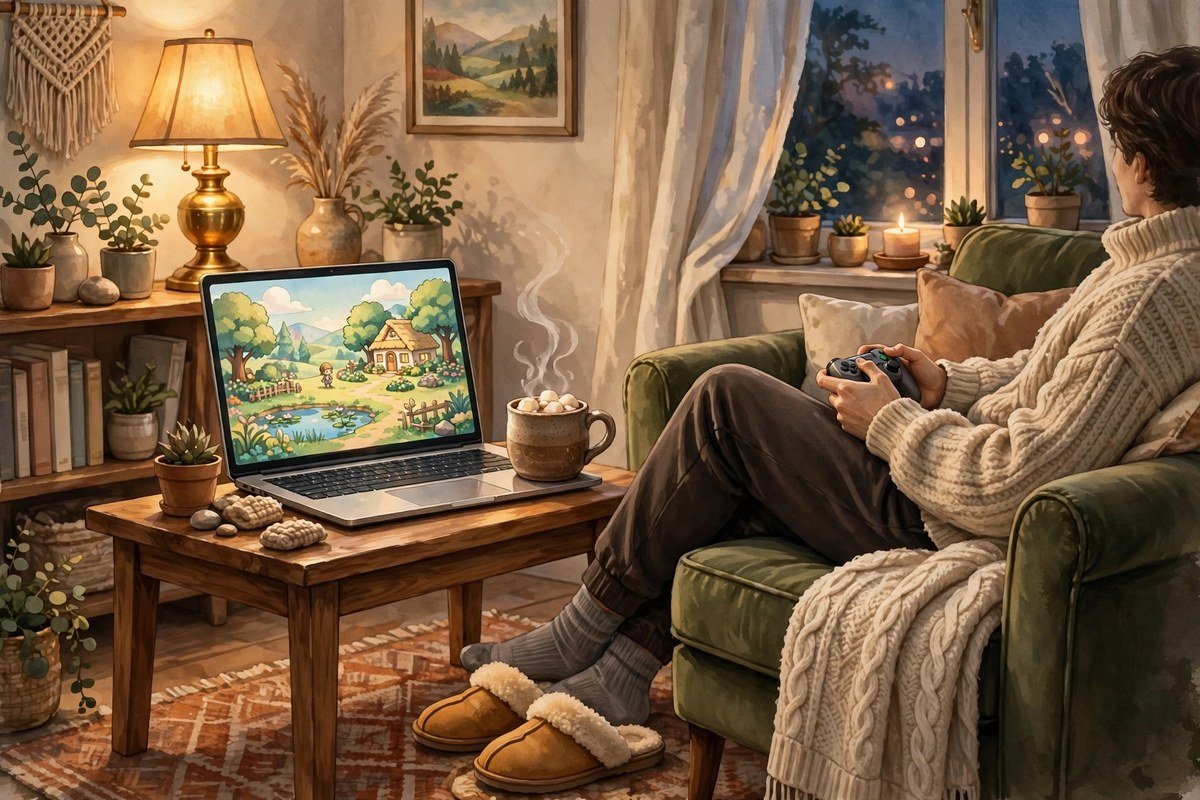
You get home from work, you sit down, you open a game for twenty minutes — and then it is midnight. The game was fun. The evening is gone. And somehow you feel less rested than when you started, even though you spent the whole evening doing something you enjoy. This is the most common complaint about evening gaming, and it has a simple cause: the game had a plan for your evening, and you did not.
1. The Problem Is Not the Game. It Is the Absence of a Plan
A game is designed to keep you playing. That is its job, and it is very good at it: one more level, one more round, one more attempt at the score you just missed. There is nothing wrong with that. The problem starts when you sit down without deciding when you will stop, because a game with no stopping point will happily fill every hour you give it.
The fix is not willpower. Willpower is what you use after the plan has already failed. The fix is a plan made before you start: a time, a game, and a number of rounds. "I will play three rounds of the puzzle game, then stop" is a plan. "I will play for a bit" is not a plan — it is an open invitation, and the game will accept it.
The plan works because it moves the decision to a moment when you are thinking clearly. Deciding to stop at midnight, in the middle of a game, with your brain full of adrenaline, is almost impossible. Deciding to stop after three rounds, at six o'clock, before you have started, is easy. Make the decision when it is easy, and the evening takes care of itself.
2. Pick the Right Game for the Hour
Not every game is an evening game. A fast, competitive game at nine in the evening will wake your brain up, not wind it down — and a wired brain does not sleep well. The games that unwind you are the slow ones: a puzzle you can think about, a gentle arcade game, a board game against the computer. They ask for attention without demanding adrenaline, and attention without adrenaline is restful.
There is a simple test. After ten minutes of a game, do you feel calmer or more alert? If you feel calmer, it is an evening game. If you feel more alert — heart beating faster, eyes wider, hands tighter — it is a morning game wearing an evening disguise. Save it for the weekend, or for the morning, and pick the calmer one tonight.
This is also why short games are better in the evening than long ones. A game that ends in three minutes gives you a natural stopping point every three minutes. A game with no end gives you no stopping point at all, and the evening disappears into it. Choose games with built-in endings — a round, a level, a match — and let the endings do the work of stopping for you.
3. The Last Half Hour Belongs to You, Not the Screen
Whatever you play, stop half an hour before bed. Not because games are harmful — they are not — but because your brain needs time to come down from anything engaging, and a game is engaging by design. The last half hour is for something slow: a book, a stretch, a conversation, a cup of tea. The game will still be there tomorrow, and tomorrow's game will be better for a good night's sleep.
This is the hardest rule to keep, because the last half hour is when the game is most tempting. You are one round from your best score, one level from the end, one match from a win. The temptation is real, and the only defence is the plan you made at six o'clock. "Three rounds, then stop" does not care about your best score. It cares about your evening, and your evening is worth more than a number on a screen.
None of this means gaming after work is a problem. It is one of the best ways to unwind there is — cheap, absorbing, and genuinely restful when it is done right. The difference between a good evening of gaming and a lost one is not the game. It is the plan, the choice of game, and the half hour you keep for yourself at the end. Make those three decisions before you press Play, and the evening will take care of the rest.
6. The Two-Game Evening: Variety as a Stopping Aid
There is a trick that makes stopping easier, and it has nothing to do with willpower. It is variety: play two different games in one evening instead of one. The first game for the first half of your time, the second for the rest — and when the second game ends, the evening ends. The switch between games does something useful: it breaks the spell.
A single game, played for an hour, creates a kind of tunnel. The same screen, the same sounds, the same loop, over and over — and the tunnel has no exit, because the game never changes. Two games create a rhythm instead: a beginning, a middle, and a natural break in between where you have to choose what to do next. That choice is the exit. It is the moment you can decide to stop, and decisions are much easier to make at a break than in the middle of a tunnel.
The two games should be different in kind. A fast game followed by a slow one, or a puzzle followed by a gentle arcade game — the contrast is what makes the switch feel like a change of scene rather than a continuation. The second game should also be calmer than the first, so the evening winds down instead of winding up. Start with the game that wakes you up, end with the game that settles you down, and the last half hour takes care of itself.
There is a second benefit. Playing two games in an evening means you never get bored of either, and you never get stuck in the loop of one. The variety keeps the evening fresh, and the freshness keeps it short — because an evening with two beginnings and two endings feels complete in a way that an evening with one endless game never does. Try it tonight: two games, a break between them, and a stopping point you chose before you started. The evening will feel longer, richer, and more restful — and you will still be in bed on time.
6. A Sample Evening: What a Good One Looks Like
It helps to picture the evening done well. You get home at six, you make dinner, and at seven you sit down with a plan: two games, three rounds each, finished by eight. The first game is a gentle arcade game — something with colour and movement, enough to shake off the day. The second is a slow puzzle, something that asks you to think without hurrying you. By eight o'clock you have played, you have enjoyed it, and you are done — with the whole evening still ahead of you.
The rest of the evening is yours: a book, a walk, a conversation, an early night. Nothing about it feels like a sacrifice, because the gaming was good — genuinely good, not the hollow kind that leaves you wired and regretful. The difference was never the games. It was the plan: a time, two games, a stopping point, and the last half hour kept for yourself. Try it for a week. The evenings will feel longer, and the gaming will feel better — because a game played on purpose is always better than a game played by accident.