
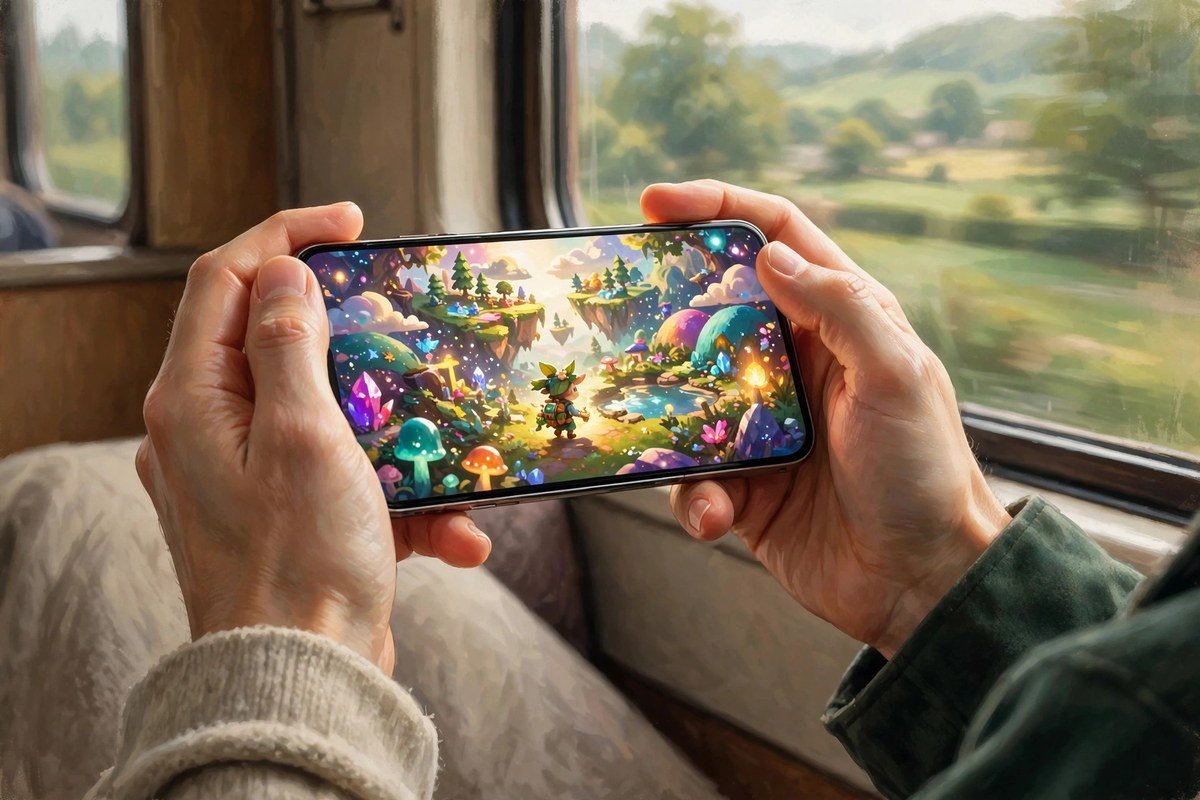
There is a particular kind of frustration that only phone players know. You are playing well, the score is climbing, and then your thumb covers the thing you needed to see. Or the bus turns, your hand shifts, and the game you were winning is suddenly a game you are losing. The phone is a wonderful games machine and a terrible one at the same time — wonderful because it is always with you, terrible because it was never designed for games. The trick is to stop fighting it and start playing the way it wants you to play.
1. Pick Games That Fit the Screen, Not Games That Fight It
The first decision is the game itself, and it matters more on a phone than anywhere else. A game designed for a keyboard — with twelve keys, a mouse, and a wide screen — will always feel cramped on a phone, because the phone is being asked to pretend to be something it is not. A game designed for touch, with one or two inputs and a board that fits in your hand, will feel natural, because the phone is doing what it is good at.
The games that work best on a phone share three qualities. They need only one or two inputs — a tap, a swipe, a drag. They show the whole game on one screen, so nothing important hides behind your thumb. And they can be played in short bursts, because phone gaming happens in gaps: a bus ride, a queue, a wait for a friend. A timing game, a puzzle, a match-three — these are phone games. A game that needs a keyboard and a mouse is a desktop game that happens to run on a phone, and it will always feel like a compromise.
There is a simple test. Open a game on your phone and play for a minute. If you find yourself wishing for a keyboard, it is the wrong game for the phone. If you forget you are holding a phone at all, it is the right one.
2. Hold the Phone Like You Mean It
How you hold the phone matters more than most players think. Portrait is the natural grip for one-handed play — the phone sits in your palm, your thumb does the work, and the game fills the screen from top to bottom. Landscape is better for games that need two hands, or a wide view of the board, because it spreads the game across a wider field and keeps your thumbs at the edges instead of in the middle.
The mistake is to hold the phone the same way for every game. A puzzle with a tall board belongs in portrait. A racer with four lanes belongs in landscape. A game that asks you to tap targets across the whole screen belongs in whichever orientation puts the targets under your thumbs rather than under your palm. Try both, and let the game tell you which one it prefers — the right orientation is the one where you can see everything and reach everything without stretching.
Two practical tips. First, turn off screen rotation lock before you start, so the phone can follow the game instead of fighting it. Second, if your thumbs keep covering the action, try playing with your index fingers while the phone rests on a table. It feels strange for a minute, and then it feels like the way the game was meant to be played.
3. The Phone Is a Different Kind of Games Machine
It is tempting to treat the phone as a small computer, and to judge it for everything it cannot do. But the phone is not a small computer. It is a different kind of games machine, with its own strengths: it is always with you, it wakes instantly, and it turns a two-minute wait into a game. The players who enjoy phone gaming most are the ones who play to those strengths — short games, quick sessions, scores chased in the gaps of the day rather than in long evening sessions.
That changes what a good score means. A high score on a phone is not a worse version of a desktop score. It is a different achievement: a good run played on a moving bus, with one thumb, in three minutes, between stops. The game does not care where you played it. The score is the same. And the phone, for all its smallness, is the machine that let you play at all.
The next time you are waiting for something, open a browser game on your phone and play one round. Not ten — one. See how it feels. If it feels cramped, try a different game, or a different grip. The right combination is out there, and once you find it, the small screen stops being a limitation and starts being what it always was: a games machine that fits in your pocket.
6. The Two-Minute Game: Designing Your Phone Sessions Around Real Life
Phone gaming happens in gaps, and the gaps are shorter than you think. The average wait — for a bus, for a coffee, for a friend who is running late — is two or three minutes, not twenty. The players who enjoy phone gaming most are the ones who design their sessions around that reality: games that fit in two minutes, sessions that end cleanly, and scores that can be chased one gap at a time.
The two-minute game has a particular shape. It starts instantly, with no loading screen worth mentioning. It ends cleanly, with a score and a restart button, so the session has a shape rather than a fade. And it can be paused or abandoned at any moment without penalty, because the bus might arrive mid-round and the game should not punish you for living your life. A game that demands twenty uninterrupted minutes is a desktop game. A game that respects a two-minute gap is a phone game, and it will be the one you actually play.
There is a practical way to find your two-minute games. Play a game for exactly one gap — one bus stop, one queue — and notice how it feels when the gap ends. If the ending feels natural, if you got a complete round in and the score is recorded, the game fits your life. If the ending feels like an interruption, if you were mid-round with no save and no score, the game does not fit — and no amount of liking the game will change that. The gap is the reality. The game has to fit the gap, not the other way around.
The reward for getting this right is a kind of gaming that desktop players never experience: a game woven into the day, played in the moments that would otherwise be wasted, adding up to hours of play across a week without ever taking an evening. The phone is not a lesser games machine. It is a different one, and its gift is the gap — two minutes, a game that fits, and a score that grows one wait at a time.
6. Your Phone's Best Feature: It Is Always There
It is easy to list what a phone cannot do as a games machine: the screen is small, the controls are cramped, the battery dies. It is harder to remember what it can do that nothing else can: it is there. In your pocket, on the bus, in the queue, in the waiting room — the phone is the only games machine that is with you in the moments when you actually have time to play. A console waits at home. A computer waits at a desk. A phone waits in your hand.
That availability changes what gaming can be. It turns wasted minutes into played minutes, and played minutes into a habit that fits a real life instead of demanding a free evening. The scores you build on a phone are not lesser scores. They are scores built in the gaps — two minutes here, three minutes there — and they add up to the same achievement, earned in the hardest conditions a game can be played in: one thumb, a moving bus, and a stop that could come at any moment. That is not a compromise. It is a different kind of gaming, and it is the kind most people actually do.