
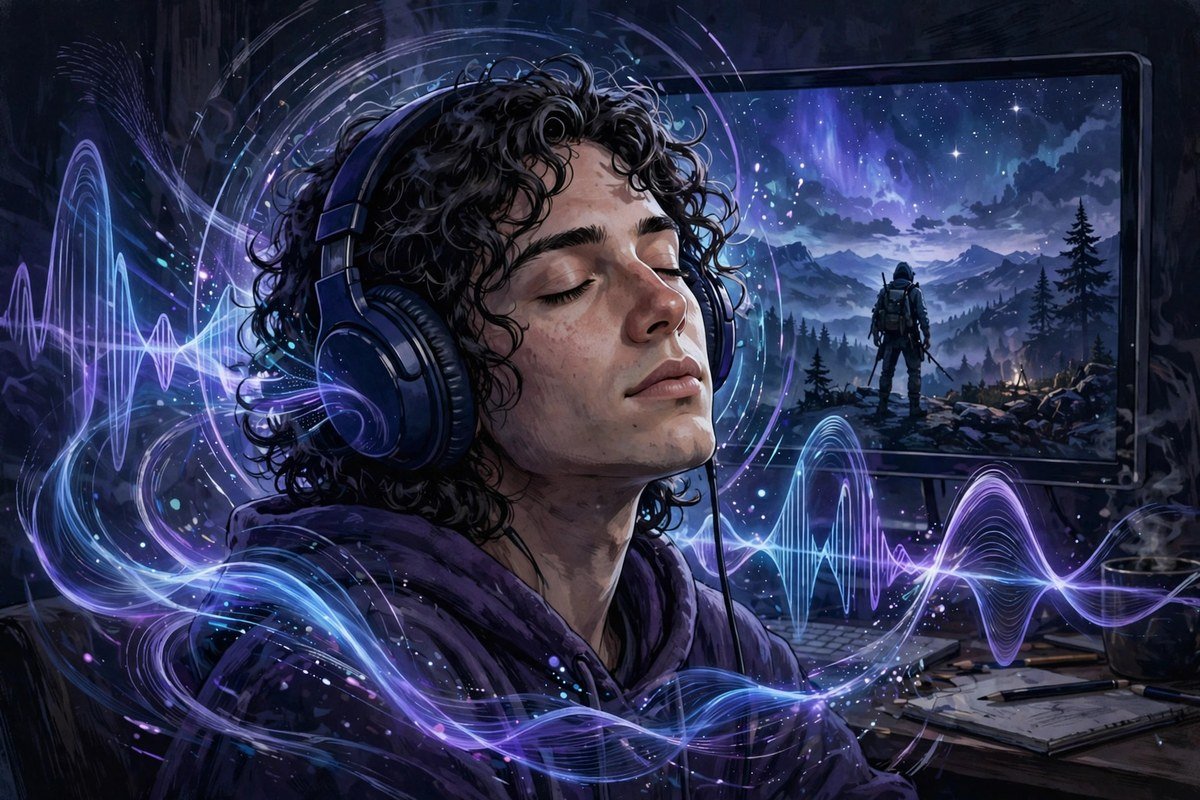
Turn the sound off in your favourite game and play it for a minute. It will feel wrong — slower, flatter, harder to follow — even though nothing on the screen has changed. The game is identical. The only difference is the sound, and the sound was doing far more work than you realised. A beep is never just a beep. It is timing, feedback, reward and warning, all packed into a fraction of a second of noise.
1. Sound Is Information Before It Is Music
The most important sounds in a game are the smallest ones. The click when you pick up a coin. The thud when you land a jump. The rising note when a chain reaction starts. None of these is music. They are information — the game telling you, faster than your eyes could, that something happened and whether it was good or bad.
This matters because your ears are faster than your eyes. Sound reaches your brain in a few milliseconds; vision takes longer, and it has to compete with everything else on the screen. A well-designed game uses that speed. The beep that tells you a match cleared arrives before you have even seen the gems disappear, and your brain registers the success a fraction of a second earlier — which is exactly enough time to plan the next move.
The sounds also teach you the game. A high, bright note means success. A low, dull thud means failure. A rising sequence means a chain. After a few minutes, you stop looking at the score and start listening to it, because the sound tells you everything the numbers do, and it tells you while your eyes are busy elsewhere. Turn the sound off and you lose a whole channel of information — which is why the game feels slower and harder without it.
2. Music Sets the Speed of Your Hands
The background music in a game does something subtler: it sets your tempo. A fast tune makes you play faster, even when the game does not require it. A slow tune makes you calmer and more deliberate. This is not a metaphor — your body synchronises with rhythm without asking your permission, and game designers know it.
That is why the music in a fast arcade game is usually fast, and the music in a puzzle game is usually slow. The music is not decoration. It is a metronome, quietly telling your hands how quickly to move. A player who finds themselves rushing in a puzzle game is often responding to music that is too fast for the game, and a player who feels sluggish in an action game may be listening to a tune that is too slow.
The practical lesson is simple: if a game feels too frantic, try turning the music down and keeping the sound effects on. You keep the information — the beeps that tell you what happened — and you lose the tempo that was pushing you faster than the game requires. Many players find their scores improve the moment they do this, because their hands finally move at the speed of their thinking instead of the speed of the soundtrack.
3. Silence Is a Sound Too
The most powerful sound in a game is often the absence of one. A game that goes quiet at the right moment — before a big jump, after a loss, at the top of a climb — is using silence the way a good storyteller uses a pause. The quiet makes the next sound matter more, and it gives your brain a moment to catch up with what just happened.
This is why the best browser games keep their sound simple. A handful of short beeps, generated by the browser itself, can carry all the information a game needs — and they can do it without a single audio file to download. The simplicity is the point. A short beep is instant, it never lags, and it never distracts from the game. A long musical sting would do the same job worse, because it would take longer and demand more attention.
The next time you play, listen for a minute before you look. Count the sounds: the success beep, the failure thud, the chain chime, the quiet between them. That little orchestra is doing half the work of the game, and it is doing it in your ears while your eyes are busy. Turn it off, and you will miss it immediately. Turn it back on, and the game will feel like itself again — because sound was never the decoration. It was part of the game all along.
6. Designing Your Own Soundscape: Mute, Music, and the Middle Path
Most players treat game sound as a switch — on or off — and miss the middle path, which is where the best experience usually lives. The sound of a game has two parts that do different jobs: the effects, which carry information, and the music, which sets the mood. They can be controlled separately, and they should be, because they serve different masters.
The effects are the information channel: the beep that says you scored, the thud that says you failed, the chime that says a chain started. These are worth keeping on, even when everything else is off, because they tell you things your eyes cannot tell you as fast. A player who mutes the effects is playing with one sense tied behind their back, and the game feels slower and harder for it — not because it is harder, but because the information arrives late.
The music is the mood channel, and it is the one worth adjusting to fit the moment. Fast music makes you play fast; slow music makes you play slow. If a game feels too frantic, the music is often the culprit, and turning it down — or off — can change the whole feel of the game without changing anything on the screen. Many players find their scores improve the moment they separate the two: effects on, music low, and their hands finally moving at the speed of their thinking.
The middle path is simple: keep the sounds that inform you, lower the sounds that rush you, and notice the difference. A game with clear effects and quiet music is a game you can play for an hour without feeling wired, and it is a game that respects your attention instead of spending it. The sound was never just decoration. It was a tool, and like any tool, it works best when you adjust it to fit your hand.
6. Listen Once, On Purpose
Try a small experiment the next time you play. Before you start, turn the sound up slightly and close your eyes for ten seconds while the game runs. Just listen. You will hear the shape of the game before you see it: the rhythm of the spawns, the pitch of the successes, the low note that means trouble. The game is talking to you, and it has been talking all along — you were just too busy looking to listen.
Then play a round with the music off and the effects on, and notice how the game changes. The information is still there — every beep, every click — but the urgency is gone, and your hands slow down to match. Then play a round the other way: music on, effects off. The game feels faster, moodier, and harder to follow, because the information channel is gone and only the mood remains. The two experiments take five minutes, and they will change how you hear every game you play afterwards. Sound was never the background. It was half the game.