
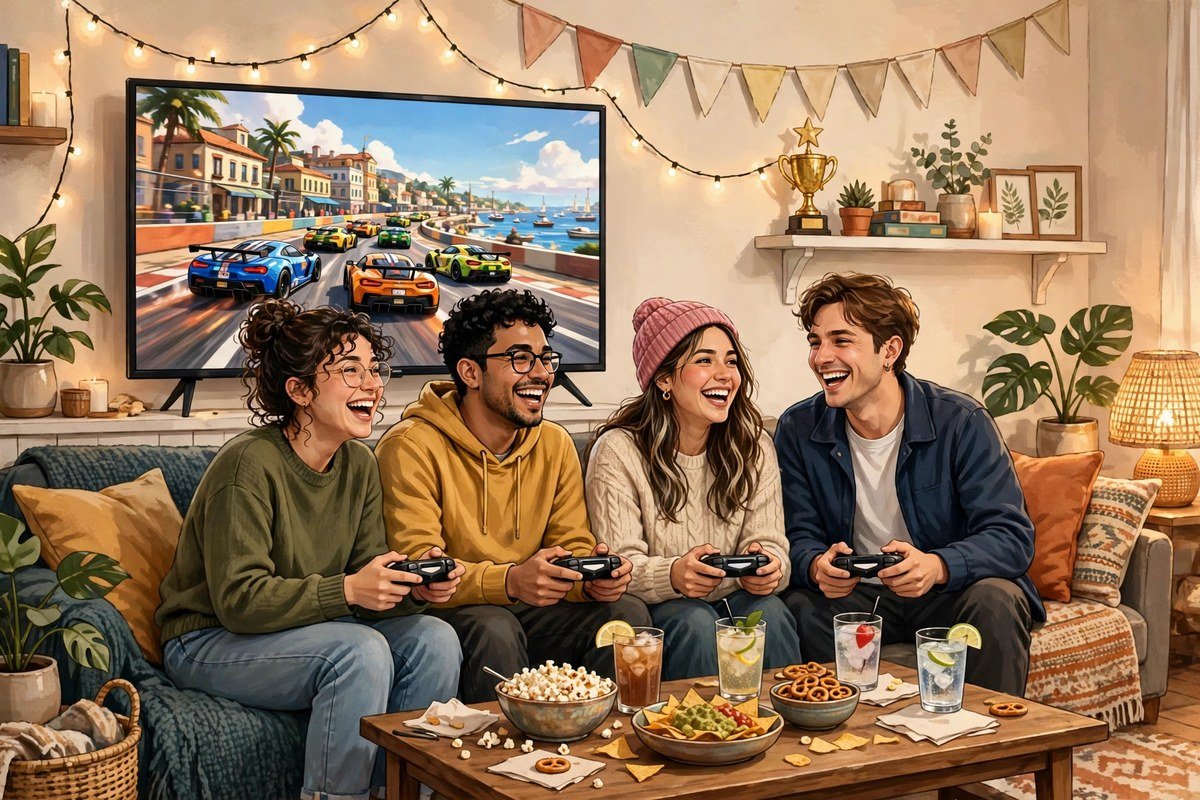
A home gaming tournament sounds like something that needs equipment, planning, and a person who knows what they are doing. It needs none of those things. It needs a laptop, three quick browser games, a piece of paper with a bracket drawn on it, and four or more people willing to take it slightly too seriously. That is the whole recipe. Everything else — the snacks, the commentary, the trophy — is decoration, and the decoration is half the fun.
1. Pick Three Games, Not Ten
The most common mistake in a home tournament is too many games. Ten games sounds generous, but ten games means ten sets of rules to explain, ten rounds of waiting, and an evening that runs out of energy before it runs out of games. Three games is the right number: enough variety that everyone finds one they like, few enough that everyone learns all three.
The games should be quick, easy to learn, and fair to newcomers. A timing game is ideal — one button, ten rounds, and a score at the end. A match-three or a puzzle game works too, because the winner is whoever scores most in sixty seconds, and sixty seconds is a perfect match length. A two-player game like table tennis or air hockey is the natural final, because the whole room can watch it and the whole room will have an opinion about it.
The other rule is that nobody should need to practise. If one player has spent a hundred hours on a game and the others have spent none, the tournament is over before it starts. Pick games nobody has mastered, explain the rules in one sentence each, and let the evening be decided by who learns fastest rather than who arrived with the most experience.
2. The Bracket Is the Entertainment
Draw the bracket on paper, in pen, where everyone can see it. This matters more than it sounds. A bracket on a screen is information. A bracket on paper, stuck to the wall, is a story — and the story is what people remember. Every match fills in a line. Every upset is visible. By the semi-final, the whole room is invested in a piece of paper.
Seed the players if you can, but do it badly on purpose. Put the two best players on opposite sides of the bracket so they meet in the final, not the first round. Put the two most competitive people next to each other, because their match will be the loudest one of the evening. And give the weakest player a kind draw, because nothing kills a tournament faster than the same person losing every match in the first ten minutes.
Keep the matches short. A match should last three minutes, not thirty. Short matches mean everyone plays often, nobody waits long, and the bracket moves quickly enough that the energy never drops. If a match runs long, it is the wrong game for the tournament, and you will know by the faces of the people waiting.
3. The Trophy Matters More Than the Prize
Every tournament needs a trophy, and the trophy should be ridiculous. A mug with a ribbon tied around it. A cardboard crown. A certificate printed on the home printer with "CHAMPION" in the biggest font available. The trophy is not a prize — it is a prop, and its job is to make the winner feel like a champion and the losers feel like they were robbed.
The prize, if there is one, should be small and silly: the winner picks the next game, or the music, or the takeaway order. A real prize changes the tournament from a party into a competition, and a competition is the wrong shape for an evening with friends. The stakes should be bragging rights and nothing else, because bragging rights are the only prize that gets better the longer you hold them.
Keep a record. Write the winner's name and the date on the trophy, or on the bracket, and keep it somewhere visible. The second tournament is always better than the first, because the first one created a champion, and a champion needs defending. That is how a one-off evening becomes a tradition — not through planning, but through a piece of paper on a wall and a name that somebody wants to beat.
4. The Real Point of the Evening
It would be easy to say the point of a tournament is the games, but the games are the excuse. The point is the room: a group of people, paying attention to the same thing, reacting to the same moments, and sharing an evening that belongs to all of them. The tournament gives that evening a shape — a beginning, a middle, and a final that everyone watches together — and the shape is what makes it memorable.
The games will be forgotten. The bracket will be remembered, the upset will be retold, and the champion will be reminded of the trophy for months. That is the return on an evening that cost nothing but a laptop and a piece of paper.
At Volton, the games are free and they open in a tab, which means the tournament can start five minutes after someone suggests it. Pick three games, draw the bracket, and let the evening happen. The worst thing that can happen is that someone loses gracefully. The best thing is that someone does not.
6. After the Tournament: Keeping the Tradition Alive
The hardest part of a home tournament is not the first one. It is the second. The first happens because someone suggests it, and the suggestion carries the evening. The second needs a reason, and the reason is the first one — the champion who needs defending, the upset that needs avenging, the score that needs beating. If the first tournament ends without a next one being mentioned, the tradition dies before it starts.
The trick is to end the first tournament by starting the second. Before anyone leaves, pick a date — next month, same time, same place — and write it on the bracket, next to the champion's name. The date does not need to be firm. It needs to exist, on paper, where everyone can see it. A date on paper is a promise, and a promise is what turns one evening into a tradition.
The second tournament should change one thing. A new game, a different format, a team round instead of singles — one change is enough to make it feel fresh without making it feel unfamiliar. The bracket stays. The trophy stays. The champion defends. And the stories accumulate: the comeback, the upset, the time someone won with a broken controller or a borrowed laptop. By the third tournament, the event has a history, and history is what makes people come back.
None of this needs organising in the formal sense. It needs one person who remembers the date, one piece of paper with the bracket on it, and one trophy — however ridiculous — that passes from champion to champion. That is the whole infrastructure of a tradition. The games are free, the evening costs nothing, and the return is a room full of people who look forward to the same night every month. That is a good trade, and it starts with a date on a piece of paper.
6. The First-Timer's Checklist
If this is your first tournament, here is the whole thing on one list. Three games, chosen in advance, each learnable in a minute. A bracket drawn on paper, stuck where everyone can see it. Four or more players, seeded so the best two meet late, not early. Matches of three minutes, no more. A trophy that is ridiculous and a prize that is small. Snacks within reach and a start time everyone knows. That is the entire plan, and it fits on an index card.
The most important item on the list is the one that is not a thing at all: the attitude. The organiser's job is not to win. It is to make sure everyone plays, everyone has fun, and the evening ends with people wanting another one. That means explaining rules patiently, keeping matches moving, and laughing at your own losses louder than anyone else's. The tournament is a party with a bracket, not a competition with guests. Keep it that way, and the first tournament will not be the last.