
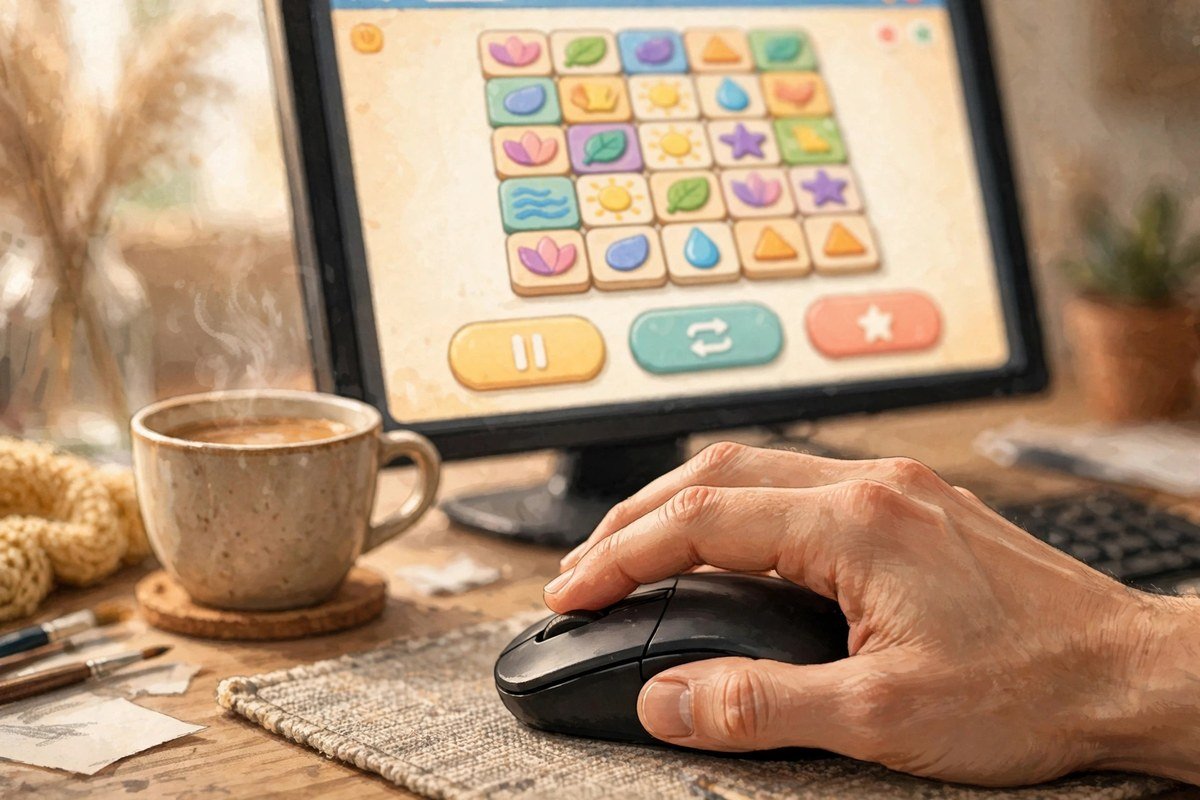
There are more ways to play a game than most game designers remember. Some players use one hand because the other is holding a baby, a coffee, or a phone. Some use a keyboard because a mouse is hard to control. Some play on a phone with a cracked screen, on a bus, with one thumb. And some play with assistive technology that turns the whole game into something else entirely. The games that work for all of them are not special accessible games. They are simply well-designed games.
1. One Input Is Enough
The most accessible games are the ones that need only one input. A timing game that needs a single tap. A puzzle that needs a single click. A runner that jumps when you touch the screen. One input means one hand, one finger, one switch — and it means the game is playable by anyone who can press a button, whatever that button is.
This is not a compromise. Some of the best games ever made use a single input, because a single input forces the designer to make the game interesting through timing and judgement rather than through complicated controls. The player is not being asked to remember twelve keys. They are being asked to decide one thing, at the right moment, again and again. That decision is the game, and it is available to everyone.
It is also worth noticing that one-input games are the games everyone plays when they are busy. The parent with a baby in one arm. The commuter with a bag in one hand. The player eating lunch. Designing for one hand is not designing for a minority. It is designing for real life, where both hands are rarely free at the same time.
2. Speed Should Be a Choice, Not a Requirement
The second thing that makes a game accessible is time. A game with no timer can be played by anyone, at any speed, because the game waits. A game with a sixty-second clock can be thrilling — and it can also be impossible for a player who needs a little longer to see the board, or to move the mouse, or to decide. Neither is wrong. But a site that only has fast games is a site that has quietly told a whole group of players that it is not for them.
The best answer is variety. Fast games for the players who want speed, slow games for the players who want time, and games in between for everyone else. A sliding puzzle with no clock. A match-three you can play at your own pace. A board game where the computer waits for you. These are not lesser games. They are the games that respect the player's time instead of spending it for them.
There is a practical test for this. Can you play the game while someone is talking to you? If the answer is yes, the game gives you time. If the answer is no, the game demands your full attention every second — which is fine, sometimes, but it should not be the only kind of game on offer.
3. Clear Feedback Beats Fancy Graphics
The third thing is feedback. A game that tells you clearly what happened — a sound, a flash, a number that changes — is a game anyone can follow. A game that communicates only through subtle visual effects is a game that leaves people behind: players with low vision, players on dim screens, players who are colour-blind, players who are simply tired.
Good feedback is redundant. The important thing happens in more than one way at once: a sound and a colour change, a number and a movement, a flash and a vibration of the score. When information arrives through two channels instead of one, nobody misses it. This is not extra work for the designer. It is the same care that makes a game feel good for everyone — the satisfying click, the clear score, the obvious result. Accessibility and good design are the same thing, seen from two angles.
The next time you open a browser game, notice how it talks to you. Does it tell you what happened, or do you have to guess? Does it wait for you, or rush you? Can you play it with one hand? The answers tell you whether the game was designed for everyone — and the games with the best answers are usually the ones you will still be playing in a month.
6. Testing a Game With One Hand: A Thirty-Second Check Anyone Can Do
There is a simple test that tells you whether a game is well designed, and it takes thirty seconds. Play it with one hand — your non-dominant hand, if you want the honest answer — and see what happens. If the game is still playable, still fair, and still fun, it was designed well. If it falls apart, if you cannot reach the controls, or if the game demands two hands to do something one hand should be able to do, the design has a gap — and the gap affects more players than the designer realised.
The test works because one-handed play exposes the same problems that affect every player with limited mobility, limited time, or limited attention. A button that is too small for a thumb is too small for a tired hand. A control that needs two keys at once is a control that excludes anyone who can only press one. A game that demands constant attention excludes anyone whose attention is divided — which, on a phone, is almost everyone.
The interesting thing is that the test rarely fails for the reasons you expect. It is not the complex games that fail. It is the simple ones that were designed carelessly — the game with the pause button in the corner your thumb cannot reach, the game where the important information sits under your palm, the game that asks you to tap two things at once. These are small failures, and they are easy to fix, once someone notices them. The one-hand test notices them in thirty seconds.
Try it on your favourite game. Play a round with one hand and pay attention to where the friction is. The friction is the design talking — telling you where the game assumed something about you that is not true. And the next time you play a game that passes the test without a struggle, notice that too. That is what good design feels like: a game that works for your hand, whatever your hand is doing, and whoever you are.
6. The Best Accessible Game Is the One You Already Love
Here is the good news: you do not need to go looking for accessible games, because the games you already love are probably accessible already. The timing game with one button. The puzzle with no timer. The board game that waits for you. These were not designed as accessible games — they were designed as good games, and good design turns out to be accessible design, because the same simplicity that makes a game easy to learn makes it easy to play for everyone.
The test is the same one you would apply to any game: can you play it with one hand, at your own pace, with clear feedback about what happened? If the answer is yes, the game is accessible, whether or not anyone labelled it that way. And if the answer is no, the game is not a bad game — it is a game designed for a different moment, a different player, a different pair of hands. There is room for both. The point is not that every game must be playable by everyone. It is that a site with room for everyone is a better site — and the games that make room are usually the ones you will still be playing in a year.