
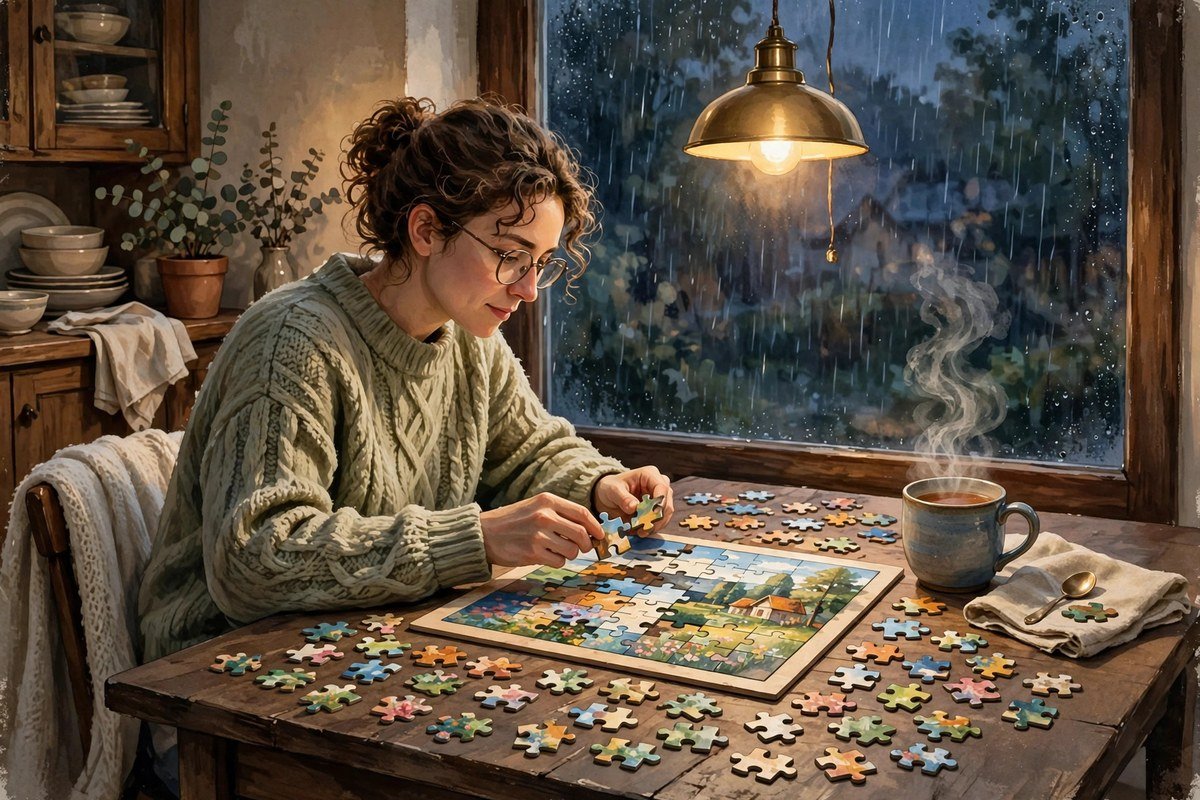
There is a particular kind of pleasure that only a slow puzzle can give you. It is not the rush of a high score or the thrill of a narrow escape. It is the quiet moment, three minutes into a puzzle, when the pattern you have been staring at suddenly rearranges itself in your head and the answer is simply there. No timer was running. Nobody was watching. The puzzle just waited, patiently, until you were ready — and then it let you solve it.
1. Slow Games Respect Your Thinking
Most games are in a hurry. They flash, they beep, they count down, and they punish hesitation. A slow puzzle does the opposite. It sits still. It lets you look at the board for as long as you like, change your mind twice, and try something that might not work. That patience is not a flaw in the design — it is the design. The puzzle is interesting precisely because you have time to think about it.
This matters more than it sounds. When a game gives you time, it gives you room to notice things: the tile that does not belong, the move that sets up two moves at once, the pattern hiding in the corner of the board. Fast games train your reflexes. Slow games train your judgement. Both are worth having, but only one of them leaves you with the feeling that you actually solved something, rather than merely survived it.
The best slow puzzles are also honest about their difficulty. They do not hide the answer behind a timer or a random shuffle. They put the whole problem in front of you and say: here it is, take your time. That honesty is relaxing in a way that fast games never are, because the only thing standing between you and the solution is your own thinking — and thinking, given enough time, usually gets there.
2. The Pleasure Is in the Untying, Not the Knot
Ask someone why they like puzzles and they will rarely say they like being stuck. They like the moment the stuckness ends. A good slow puzzle is built around that moment: it gives you a knot that looks impossible, lets you sit with it, and then — usually when you stop trying so hard — lets you see the thread to pull. The pleasure is not in the difficulty. It is in the untying.
This is why the best puzzles have a particular shape. They start simply, so you feel clever. Then they get complicated, so you feel stuck. Then they resolve, so you feel clever again — but cleverer than before, because you earned it. The whole arc takes five minutes, and it leaves you with a small, specific satisfaction that a high score never quite delivers: the feeling that you understood something you did not understand before.
It is also why slow puzzles age well. A fast game is exciting the first time and routine the tenth. A good puzzle is interesting every time you meet it, because the interesting part is not the puzzle — it is the thinking you do around it, and your thinking is different every day.
3. Slow Puzzles Are the Best Games for Short Breaks
Here is something counterintuitive: the slowest games are often the best ones for the shortest breaks. A fast game needs your full attention for every second you play it, which means a two-minute session is two minutes of intensity. A slow puzzle needs nothing from you except a glance. You can open it, look at the board for thirty seconds, make one move, and close it again — and the puzzle will be exactly where you left it, waiting.
That makes slow puzzles the ideal game for the gaps in a day: the wait for a kettle, the two minutes before a meeting, the pause between tasks. You do not need to commit to a session. You need a problem worth thirty seconds of your attention, and a slow puzzle is exactly that. It is also the rare game that leaves you calmer than it found you, because thinking about a puzzle is a rest from thinking about everything else.
There is a practical tip hidden here. If you play slow puzzles in short bursts across the day instead of one long session, you will solve them faster. The break between sessions is when your brain does its best work on a puzzle — the answer that would not come at your desk often arrives in the shower, on a walk, or while you are making tea. The puzzle does not mind waiting. That is its whole point.
4. What to Look for in a Good Slow Puzzle
Not every slow game is a good puzzle. A good one has three qualities, and you can spot them in the first minute. First, the rules fit in a sentence. If a puzzle needs a manual, it is not a puzzle — it is homework. Second, every position is solvable. A puzzle that can trap you through no fault of your own is not testing your thinking; it is testing your patience with bad design. Third, the difficulty comes from the arrangement, not from the clock. A puzzle that is hard because you have ten seconds is not hard — it is rushed.
The sliding tile puzzle is the classic example. Fifteen numbered tiles, one empty space, one rule: slide a tile into the gap. That is the whole game, and it has been humbling players for more than a century. It works because the difficulty lives entirely in the arrangement. The puzzle never rushes you, never hides information, and never punishes you for thinking. It just waits, and the waiting is the game.
The same test applies to merge puzzles, match-three games played without a timer, and logic grids. If you can explain the rules to a friend in one sentence, and the game still takes you ten minutes to solve, you have found a good one.
5. Why Volton Keeps Slow Puzzles on the Shelf
Fast games get the attention because they are loud. Slow puzzles get the loyalty, because they are the games people come back to. The player who finishes a fast game moves on to the next one. The player who solves a slow puzzle sits for a moment, enjoys the feeling, and then starts another — because the feeling is the point, and it is always available.
That is why the puzzle shelf on Volton is built the way it is: games with no timer, no penalty for thinking, and no pressure to be fast. A sliding puzzle that waits for you. A merge game that lets you plan. A match-three you can play at your own pace. They are not the loudest games on the site, and they do not need to be. They are the ones you will still be playing in a month, one quiet move at a time, because the pleasure they offer — a problem, patiently solved — never gets old.
6. The Puzzle You Solve Tomorrow
There is a particular kind of puzzle that you cannot solve today. You have looked at it for ten minutes, tried everything you can think of, and the answer will not come. So you close it, and you do something else — and then, tomorrow morning, while you are making coffee or waiting for a bus, the answer arrives, whole and obvious, as if it had been there all along. It was there all along. You just needed to stop looking at it.
This is one of the quiet superpowers of slow puzzles: they keep working on you after you stop playing. Your brain does not clock off when you close the tab. It keeps turning the problem over in the background, trying arrangements, testing moves, and it does this best when you are not watching — while you walk, while you sleep, while you do something entirely unrelated. The answer that would not come at your desk often arrives in the shower, because the shower is where your brain is free to think without the pressure of thinking.
The practical lesson is to treat an unsolved puzzle as a seed, not a failure. Leave it. Come back tomorrow. The puzzle will still be there, exactly as you left it, and you will be a slightly different player than you were — one who has had a night to think about it without trying. Some of the best puzzle solutions in history arrived this way, after a night's sleep rather than an hour of effort, and the players who know this are the ones who never force a solution. They plant the puzzle, walk away, and let it grow.
It is also why slow puzzles are the best games to play before bed. Not because they tire you out — they do the opposite — but because they give your brain something gentle to work on overnight. You close the game, you sleep, and somewhere in the night your brain quietly solves the thing you could not solve awake. You wake up with the answer, and the puzzle is solved before you have even opened it. That is a strange and lovely feeling, and it belongs only to slow games.