
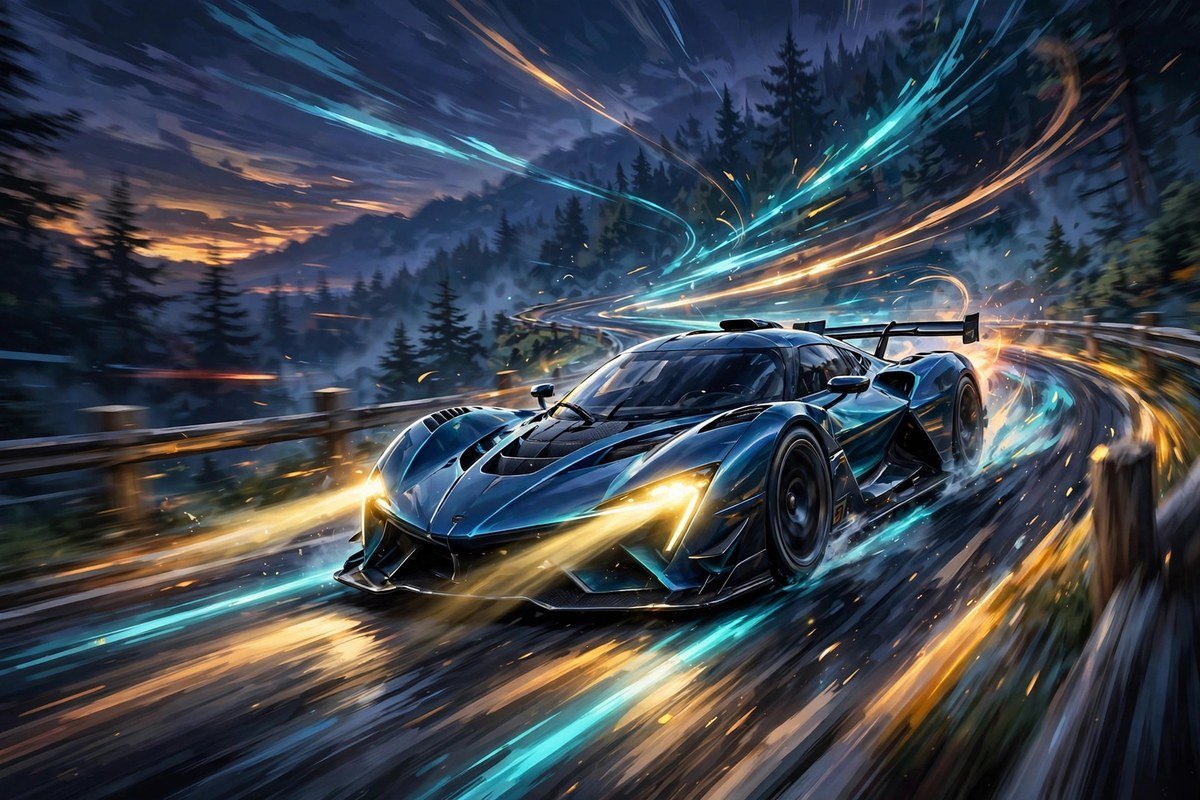
Here is a strange fact about racing games: the fastest-feeling game you have ever played was probably not the fastest. A game can crawl along at a modest speed and feel like a rocket, while another can tear down a motorway at two hundred miles an hour and feel like a Sunday drive. The speedometer lies. What you feel is not speed — it is the design around the speed, and the design is doing far more work than the number.
1. The Scenery Does the Speeding
The single biggest contributor to felt speed is how fast the world goes past you. A road lined with trees, signs, buildings and shadows gives your eyes a constant stream of things to measure, and the faster those things pass, the faster you feel. A road across an empty desert, with nothing beside it, gives your eyes nothing to measure — and without measurement, speed disappears.
This is why the best racing games are full of clutter. Not random clutter, but the kind that rushes past at the edges of your vision: roadside posts, lane markings, streetlights, the shadows of bridges. The centre of the screen, where you are looking, is kept relatively calm, because that is where you need to think. The edges are where the speed lives, in a blur of passing objects that your peripheral vision reads as pure velocity.
It is also why narrow roads feel faster than wide ones. On a wide road, the edges are far away and the scenery passes slowly. On a narrow road, the edges are close, the scenery rushes past, and every metre feels earned. The road has not changed speed. Your sense of it has — because the world is closer, and closeness is speed.
2. Sound Is a Speedometer You Cannot See
The second contributor is sound. An engine note that rises with your speed tells your ears what your eyes cannot quite measure, and a wind sound that grows louder as you accelerate adds a layer of urgency that no number on a dashboard can match. Turn the sound off in a racing game and it immediately feels slower — not because the game changed, but because your ears stopped confirming what your eyes were seeing.
The best racing sound is not realistic. It is exaggerated: the engine is louder than a real engine, the wind is stronger than real wind, and the near-miss whoosh when you pass a car is bigger than any real sound. The exaggeration is the point. The game is not trying to sound like a car. It is trying to make you feel like you are going fast, and feeling fast is a matter of sound as much as speed.
This is worth knowing as a player, because it explains why some games feel thrilling at low speeds and others feel dull at high ones. The thrilling game is the one whose sound matches its speed. The dull one is the one where the sound and the speed disagree — and your brain trusts the sound more than the number.
3. Risk Is the Real Accelerator
The third contributor is the one most players never notice: risk. A game feels fast when something bad could happen at any moment. Traffic ahead, a narrow gap, a corner you might not make — these create a tension that your brain reads as speed, because the faster you go, the less time you have to react to them. Remove the risk and the speed vanishes with it. A car alone on an empty road, however fast, feels calm. A car threading traffic at half the speed feels like a rocket.
This is the secret of the best browser racers. They are not fast in absolute terms — they cannot be, on a small screen with simple graphics. But they are full of risk: cars to dodge, coins to grab, gaps that close as you approach. Every second asks you a question, and the questions arrive faster as the speed rises. That is what makes the game feel fast — not the number on the speedometer, but the rate at which decisions arrive.
The next time a racing game makes your palms sweat, ask yourself what is actually happening. The speed is probably modest. The scenery is rushing past, the sound is rising, and the traffic is closing in — and your brain, adding it all up, has decided that you are going very fast indeed. It is wrong about the number. It is right about the feeling. And the feeling is the game.
6. The Near Miss: Why Almost Crashing Feels Faster Than Going Fast
There is a moment in every racing game that every player knows: the near miss. A car fills your windscreen, you swerve at the last possible second, and the two vehicles pass with inches to spare. Your heart pounds. Your hands tighten. And for a second, the game feels faster than it has ever felt — even though your speed never changed. The near miss is the most powerful speed effect in racing games, and it has nothing to do with speed at all.
The reason is simple: a near miss is a threat, and threats focus the mind. When a car is about to hit you, your brain stops thinking about the road and starts thinking about survival — and survival feels urgent in a way that cruising never does. The urgency is what you feel as speed. The car did not accelerate. Your attention did. And the game, by putting a car in your path at the last moment, borrowed your own survival instinct to make itself feel faster.
Good racing games manufacture near misses deliberately. They place traffic so that the gaps are narrow but passable, the cars close but avoidable — close enough to scare you, far enough apart to let you through. The design is a balancing act: too much space and the road feels empty; too little and the game feels unfair. The sweet spot is the gap that looks impossible from a distance and turns out to be exactly wide enough, every time, if you steer well.
The next time a near miss makes your heart race, notice what actually happened. You did not go faster. You came closer to something bad, and your brain did the rest. That is the trick, and it is the reason the best racing games feel fast at speeds that would bore you on a real road. The speed was never in the car. It was in the gap, the threat, and the inch to spare.
6. Try It: Feel the Tricks Working
The next time you play a racing game, try noticing the tricks as they happen. Watch the edges of the screen and see how fast the roadside posts go by — that blur is the speed you feel. Listen to the engine note as it rises with your speed — that sound is the speedometer your ears believe. And notice the moment a car pulls across in front of you: your heart beats faster, your hands tighten, and the game feels quicker than it did a second ago, even though nothing changed except the traffic.
Once you see the tricks, you will never unsee them — and the games will get better, not worse, because you will appreciate the craft. The designer who placed the roadside posts, tuned the engine note, and timed the traffic was not cheating you. They were building a feeling out of pieces, and the feeling is the game. Speed was never a number. It was a trick, played well, on a screen — and knowing how the trick works makes the performance more impressive, not less.